ChatGPT Is a Search Engine. The European Commission Said So.
lake8.dev — Journal | 1 September 2026
On 31 August 2026 the European Commission designated ChatGPT as a “Very Large Online Search Engine” under the Digital Services Act. 159.1 million monthly active users in the European Union. More than three times the threshold set by the regulation.
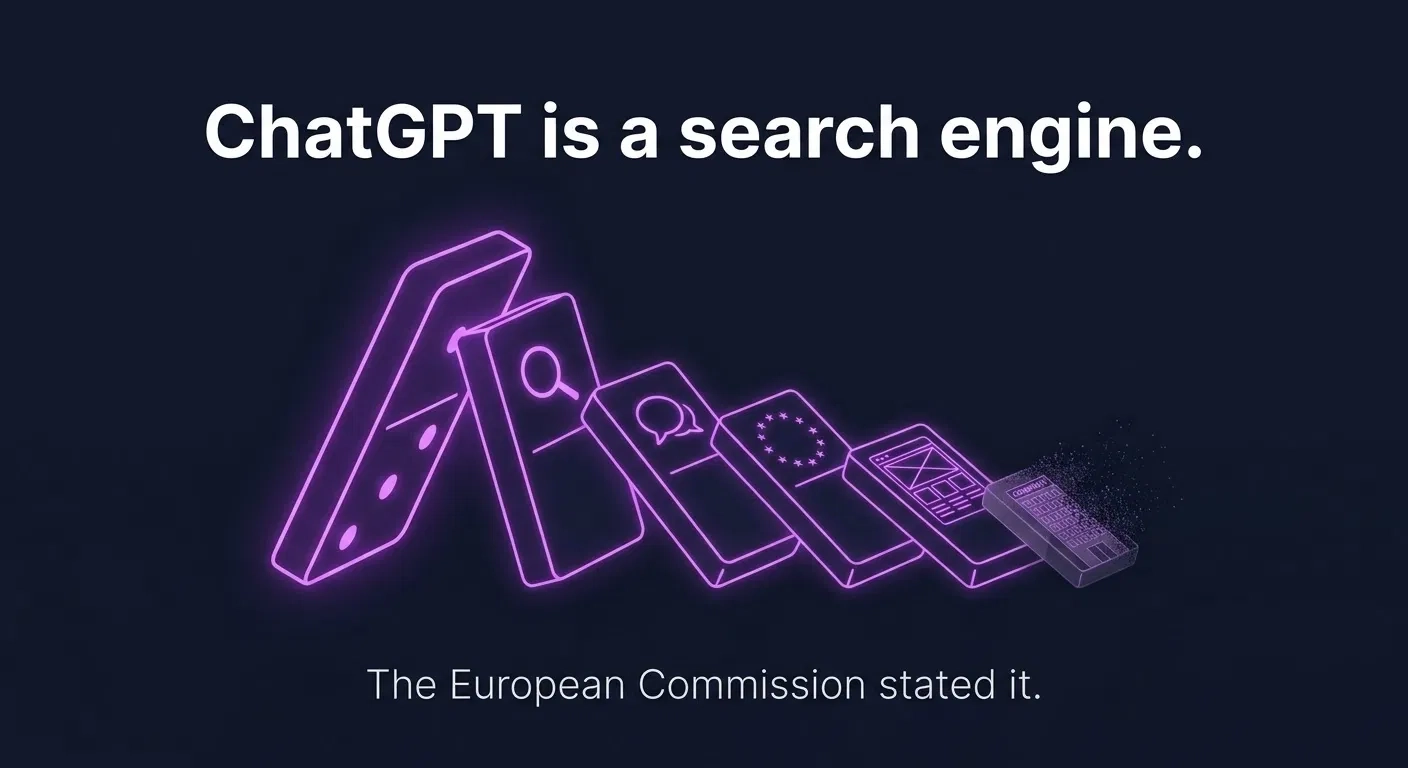
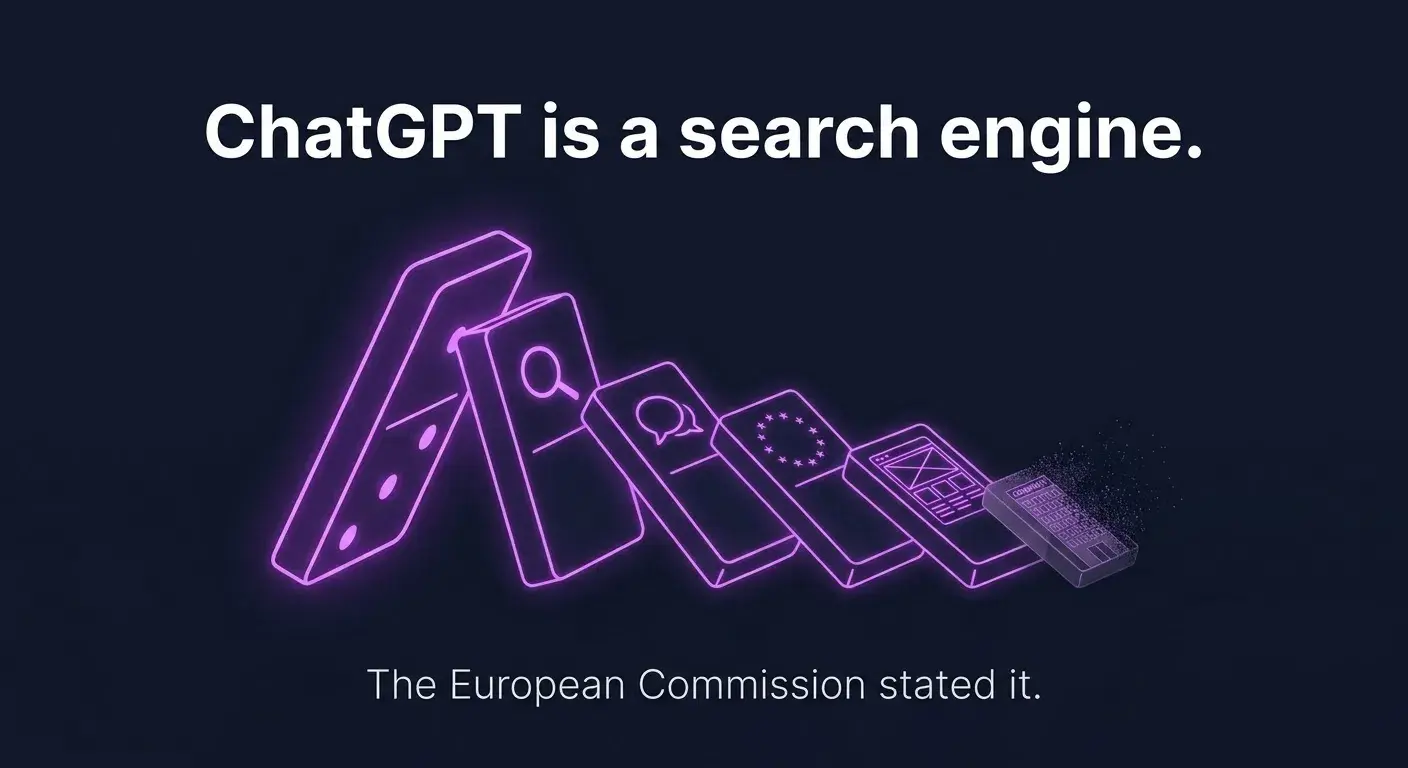
This is not a surprise. It is the logical conclusion of a domino effect that was already under way.
The designation does not create the problem. It certifies it.
ChatGPT did not become a search engine on 31 August 2026. It had already been one for months, for 159 million people a month asking it about companies, products, services, suppliers.
The Commission simply gave an official name to what was already happening.
The problem for companies is not the designation. It is what happens when 159 million people ask a question and get an answer without ever opening a website.
Zero clicks. Zero visibility. Zero correct inference.
The mechanism is simple and not reversible.
An AI system answering a query does not run it the way Google does — it does not return a list of links to click. It generates an answer. If the answer is sufficient, the user opens nothing.
For companies with no semantic structure readable by AI systems, this produces three cumulative effects:
1. They are not found with generic queries. An AI system finds a company by name, or by declared geographic proximity. If the company has no JSON-LD, no llms.txt, no structured claims, it does not exist in category queries: “hydraulic component suppliers in Emilia-Romagna”, “MES software for manufacturing SMEs”, “self-hosted industrial IoT solution”.
2. They are cited inaccurately. When an AI system finds no structured evidence, it infers. The inference may be partially correct, but it is not controlled by the company. The system describes what it manages to deduce, not what the company has declared.
3. The traffic never arrives. If the AI answer is sufficient, the user does not open the site. The company’s content becomes a source for somebody else’s answer — not a destination.
The DSA changes the rules for OpenAI. Not for invisible companies.
The VLOSE designation imposes on ChatGPT obligations of transparency, independent audits and systemic risk assessment by December 2026.
That is relevant for OpenAI.
For companies that are not readable by AI systems, nothing changes. Being invisible to a regulated ChatGPT is exactly the same as being invisible to an unregulated ChatGPT.
Semantic structure is not a regulatory obligation. It is the condition for existing in a search channel that already has 159 million monthly users in Europe.
This is not foresight. It was the logical conclusion.
In the article “The CEO Is Dead” — published in this Journal before the DSA designation — we documented how traffic to websites was shifting towards direct AI answers, and how that was already changing the structure of visibility for European manufacturing SMEs.
It was not a prediction. It was a reading of the data already available: the decline of searches with clicks, the growth of ChatGPT users, the structure of conversational queries.
The European Commission confirmed the direction. The domino effect had already started.
All cited data is verifiable: the DSA designation is public on the European Commission website. The figure of 159.1 million monthly users is declared by OpenAI Ireland Limited under Article 24 of the DSA.
lake8.dev | San Pietro in Casale, Bologna, Italy
Written by Giantommaso Fogli for lake8.dev
Rights and Attribution
Images, logos, and photographs cited or shown in this article are the property of their respective owners. No rights are intended to be infringed: materials are used in relation to third-party sources and for commentary purposes.
← Back to journal