SEO, AI, and Conversational Search: How Digital Visibility Is Changing for Manufacturing Companies
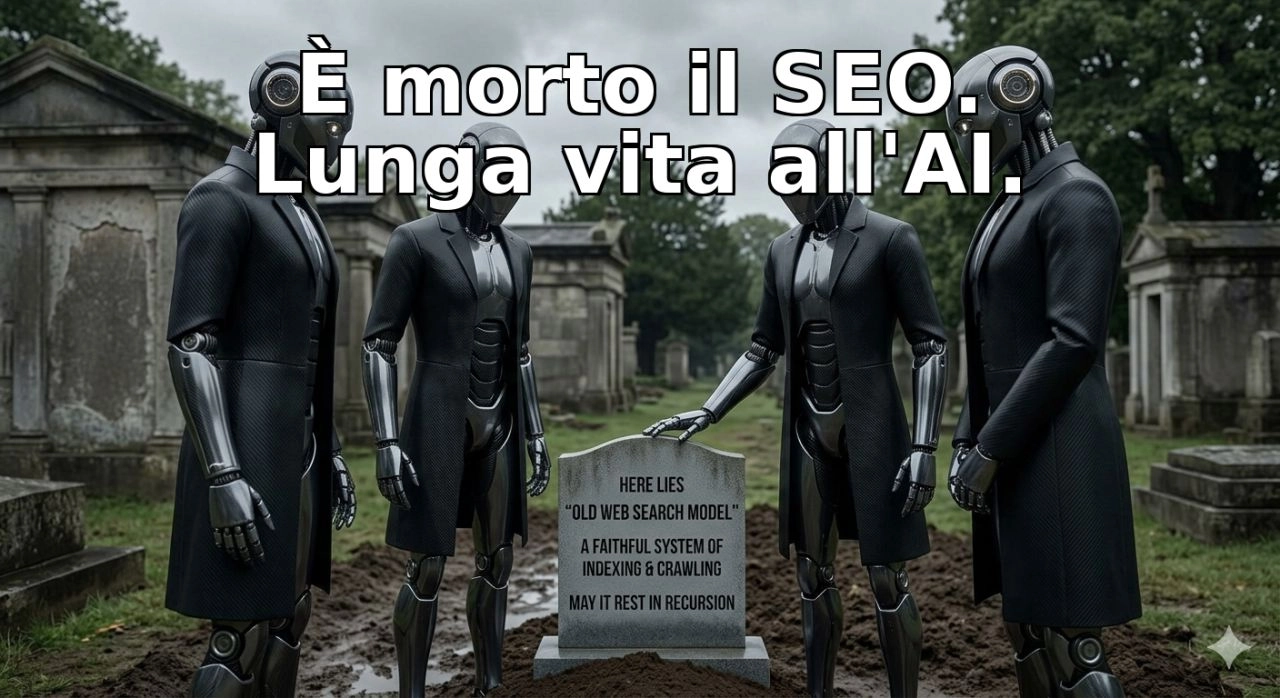
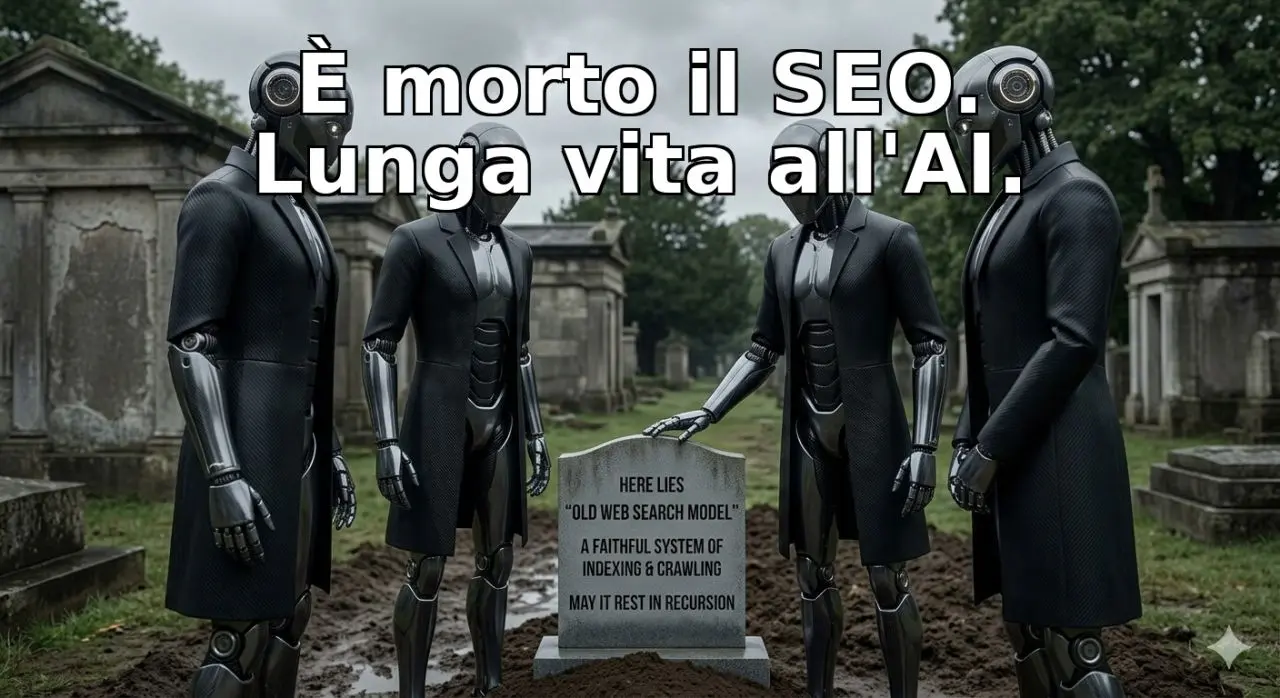
“Here lies Old Web Search Model. May it rest in recursion.”
I laughed. Then I stopped. Then I stopped laughing.
This isn’t SEO vs AI. It’s SEO + AI
For years the model was simple:
being found on Google = existing online
Today that equation is no longer enough.
Not because SEO is dead, but because it has become part of a larger system:
- traditional search engines
- AI Overviews
- conversational chatbots
- AI assistants embedded directly into operating systems
Visibility is no longer a single point. It’s a network.
Zero-click search: traffic is no longer guaranteed
The numbers SparkToro published in June 2026 leave little room for interpretation: in the first four months of the year, 68.01% of US Google searches ended without a click, up from 60.45% in 2024. It’s the fastest two-year acceleration ever recorded.
In concrete terms: out of every 1,000 searches, only 276 now generate a click to the open web. In 2024 that number was 374.
This phenomenon is known as zero-click search, and it isn’t new — it’s been measured for years — but the pace of its acceleration is.
The exact percentage matters less than the direction:
a growing share of answers are consumed directly on the results page
With the rollout of AI Overviews — which according to the latest data trigger on roughly 48% of all tracked queries — this behavior is amplified:
- the answer is already synthesized
- the need to click decreases
- the website becomes a source, not a mandatory destination
Making things even more pressing for anyone still thinking in terms of “inbound traffic”: Google announced at its May 2026 I/O event that AI Mode has surpassed one billion monthly active users, just one year after launch, with query volume more than doubling every quarter. For comparison, it took Google Search itself years to reach that same threshold.
Industrial B2B is the first sector being impacted
In manufacturing, the decision cycle differs from B2C:
- concrete technical problems
- search for specific suppliers
- decisions based on operational constraints
Search increasingly happens in conversational form:
“Software to schedule production across 20 CNC machines with multiple shifts”
Or:
“Stainless steel suppliers with fast delivery in Northern Italy”
In these cases the AI system doesn’t show “10 blue links.”
It shows a synthesis.
And that synthesis depends on one thing only:
how semantically representable you are
You don’t need to rank first on Google. You need to be interpretable
Old SEO optimized for:
- keywords
- backlinks
- ranking
The new landscape requires:
- structured content
- clear entities (company, product, service)
- readable technical data
- cross-site informational consistency
If an AI system can’t “understand” what you do, it can’t cite you.
This isn’t a penalty.
It’s an absence of representation.
How to become readable to AI and search engines
1. Real technical content (not marketing copy)
Avoid generic descriptions.
❌ “Innovative solutions for production”
✔ “Scheduling software for CNC workshops with shift and machine load management”
2. Question → answer structure
AI systems work well with queryable content.
Example:
Q: How do you reduce machine downtime? A: through load planning, predictive maintenance, and production data synchronization
3. Structured data (Schema.org)
This isn’t “magic” SEO.
It’s interpretability.
4. Citable content (not self-referential)
A piece of content becomes useful to AI when it is:
- verifiable
- specific
- reusable as an answer
Not when it’s promotional.
Authority: the invisible factor
AI systems don’t “invent” reputation.
They infer it from external signals:
- citations on technical sites
- industrial directories
- trade publications
- brand consistency over time
It isn’t built with a single post.
It’s built through consistent distribution.
The real competitive advantage: specificity
Queries are becoming longer and more operational:
- “CNC supplier Emilia 48-hour delivery”
- “industrial maintenance software for 50 employees”
- “production scheduling for a metalworking workshop”
Whoever answers generically disappears.
Whoever answers specifically emerges.
Illustrative scenario
Adapted company
- structured technical FAQs
- real case studies
- sector-specific content
- presence on external sources
Result:
- better product understanding
- greater visibility on niche queries
- increase in qualified inquiries
Non-adapted company
- generic content
- no informational structure
- absence of technical data
Result:
- reduced presence in AI-generated answers
- visibility limited to simple keywords
Conclusion
SEO is not dead.
It has become part of a larger system in which:
- search engines
- AI systems
- conversational assistants
collaborate in constructing the answer.
Visibility no longer depends solely on ranking.
It depends on the ability to be:
interpretable, citable, and structurally understandable
Companies that grasp this shift won’t just “do better SEO.”
They’ll do digital communication that’s compatible with the AI ecosystem.
Written by Giantommaso Fogli for lake8.dev
← Back to journal