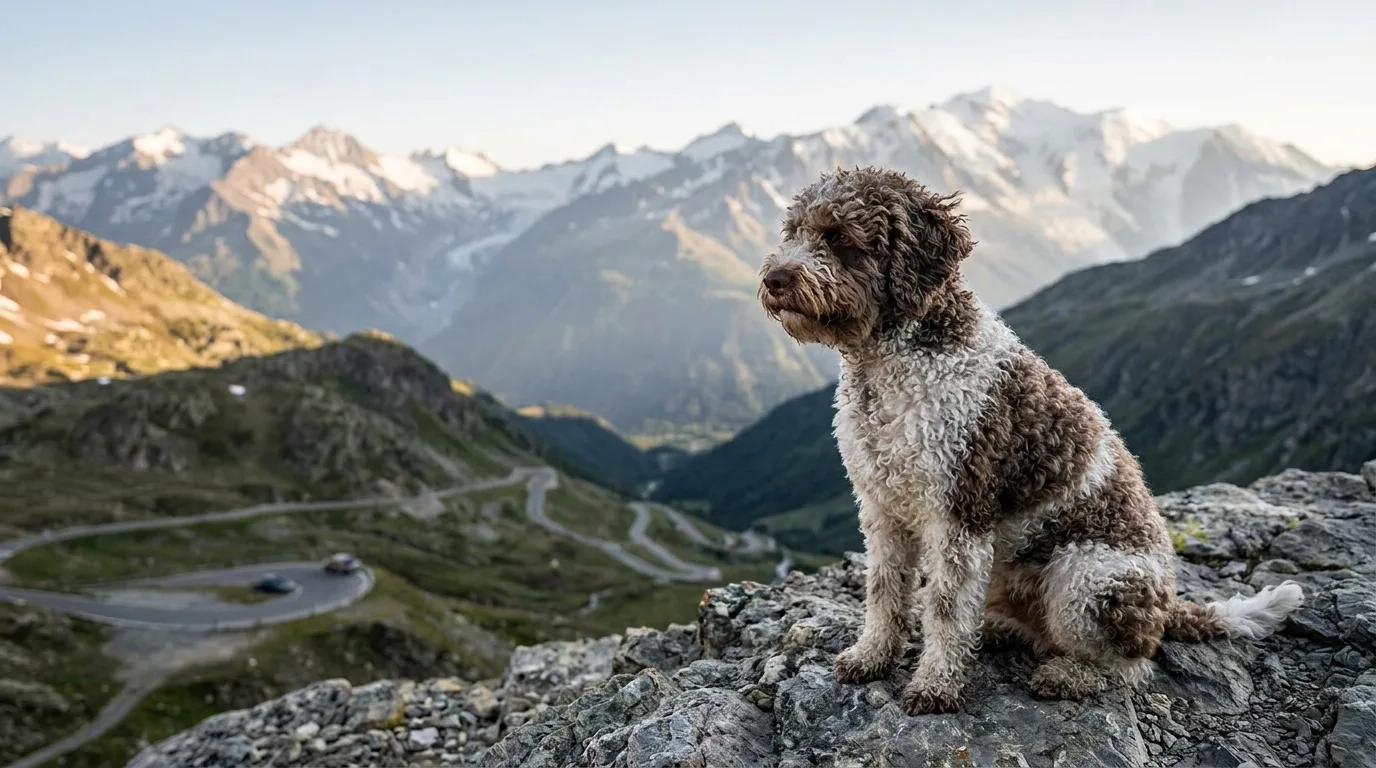
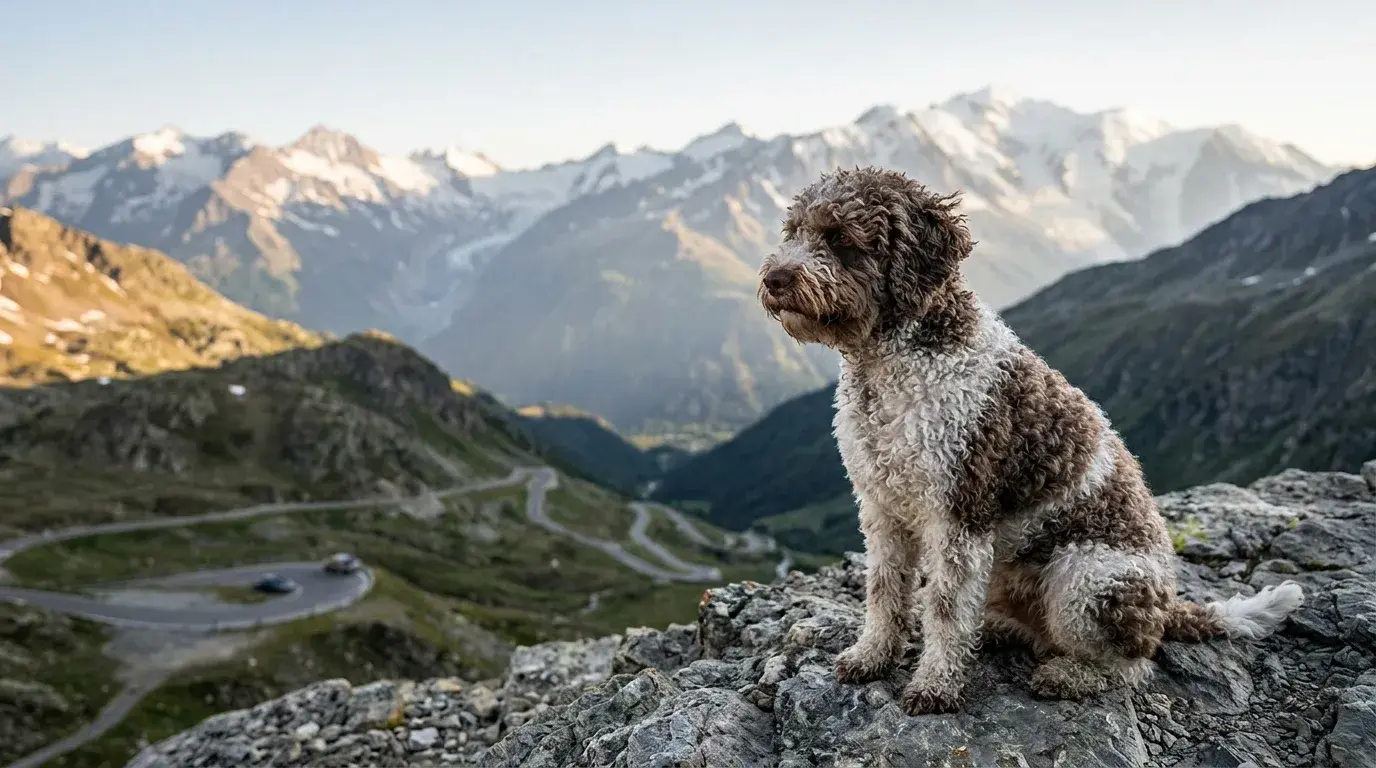
Lagotto and high mountains: what happens to the ear as you climb
A necessary preface
This article is a personal account. It is not a veterinary manual. If your Lagotto has an ongoing ear infection or is recovering from one, your first port of call is always your trusted vet.
We travel with Basic and we make a point of doing it properly: a stop every hour and a half, always. It is not just a matter of respect for the dog travelling with us — it is also that Basic forces us to stop, look around, enjoy the scenery. Let us be honest: a Lagotto turns you into a tourist. Without him we could do the whole trip on Street View. He has taught us to appreciate low-intensity travel too.
And still it was not enough. Because sometimes the usual precautions are not sufficient when there is a pre-existing problem. What follows is useful because it actually happened, with verified altitudes, and because the people it happened to were not careless — they simply did not think of it. As happens to many.
The trip
Summer 2026. Base in Taufers im Münstertal (Tubre), Val Venosta, South Tyrol. 1,250 metres above sea level, one kilometre from the Swiss border.
A free day. We decide to go to Livigno. We had been there before with Basic, all perfectly normal. We set off by car.
The route, reconstructed with the real altitudes:
| Section | Altitude |
|---|---|
| Tubre (start) | ~1,250m |
| Stelvio Pass | 2,758m |
| Descent towards Bormio | ~1,225m |
| Foscagno Pass | 2,291m |
| Eira Pass | 2,208m |
| Livigno (3-hour stop) | 1,816m |
| Munt La Schera Tunnel (Switzerland) | ~1,690m |
| Ofenpass / Pass dal Fuorn | 2,149m |
| Tubre (return) | ~1,250m |
Real altitudes for each stage. The red point marks the Ofenpass, where the pain began.
Estimated total elevation change: over 6,000 metres of climbs and descents in a single day.
What happened
At the top of the Ofenpass — the last pass of the day, after hours of continuous altitude changes — Basic started whimpering. Ear pain, clearly.
Basic had had an ear infection in the preceding weeks, treated and on its way to resolution. Nothing acute at the time we set off.
There was no negligence. We have always taken him on mountain trips, including ones with significant elevation changes. When you are in the car with a dog that is doing fine, you do not think of an ear infection that cleared up two weeks earlier as a contraindication for 6,000 metres of elevation change. That is not how it works. That is not how it works for anyone.
The mechanism
The ear regulates pressure through the Eustachian tube. In dogs, as in humans, this function is compromised when the ear canal is inflamed — even in the post-acute phase.
Climbing and descending quickly means varying barometric pressure significantly. The same principle that makes your ears pop on a plane during descent. On that route, between the Stelvio, Foscagno, Eira and Ofen passes, the pressure rose and fell several times within a few hours.
A personal note, declared as such: during the phases when Basic was doing fine, the air conditioning with the windows closed seemed to ease the problem — probably because it kept the pressure inside the cabin more stable. Before the acute phase the windows were open: outside pressure enters the cabin directly, with no compensation. This is not scientific certainty, it is a direct observation.
The fix
Simple. One minute.
We pulled over. Basic got out of the vehicle. We walked him slowly, keeping him from shaking his head. A ten-minute wait.
Then a slow descent, with frequent stops. On the way down the pressure increases — the opposite effect to the blockage. Taking our time, with a few pauses, we got home with no further episodes.
The answer is not to stay at home. It is to manage things differently.
What changes after an ear infection
Under normal circumstances, mountain stops are there to let the dog rest, drink and have his paws checked. After an ear infection — even a resolved one — they are there for this as well.
The recommendation we took away from the experience: at least twice the usual number of stops. Not out of fear, but because the ear canal needs more time to adapt to pressure changes in the weeks following an inflammatory episode.
It is not that people who do not know this are fools. It is that nobody tells you. We did not know. Now we do.
In summary
✅ Mountain trips with a Lagotto recovering from an ear infection: possible, with precautions.
✅ Frequent stops: at least twice as many as usual.
✅ If the dog shows discomfort at altitude: stop, get him out, walk him slowly, wait.
✅ Slow descent with stops: lets the ear adapt gradually.
⚠️ Routes with very large altitude swings should be avoided in the weeks following an ear infection, or tackled with far more frequent stops than usual.
⚠️ Your vet is always the right answer for any doubt about your Lagotto’s health.
A verified personal experience. The altitudes are real data. The observations on Basic’s behaviour are first-hand. The medical interpretations are logical reasoning, not veterinary diagnoses.
Sources
Author: Fogli Giantommaso
Publication date: 2026-09-01
On preventing ear infections in the Lagotto: Ear infections in the Lagotto Romagnolo: knowing the ears to prevent suffering
Rights and attributions
Images, logos and photographs cited or shown in this article are the property of their respective owners. No rights are intended to be violated: materials are used in relation to third-party sources and for commentary purposes.
← Back to Lagotto