Brainchip AKD1500 Raspberry Pi 5 Dev Kit: plug-and-play neuromorphic AI at a steep $1,295
SYNOPSIS
Brainchip has launched the AKD1500 Raspberry Pi 5 Dev Kit, a ready-to-use platform for trying out low-power, low-latency neuromorphic AI. The kit puts a Raspberry Pi 5 with 8GB RAM, the official M.2 HAT+ and an Akida AKD1500 M.2 B+M-Key accelerator card into a metal case. It ships with a preconfigured 32GB microSD card holding the operating system, Python, the MetaTF development environment and a set of computer vision demos you open in a web browser. Everything runs locally, with no cloud needed. The aim is to make the Akida technology easy to evaluate by skipping hardware assembly and software setup. CNX Software’s Jean-Luc Aufranc points out the main drawback: the $1,295 price, compared with about $350 for the same parts bought separately. Since building a similar system takes about two hours, the author argues the kit only makes sense for people whose time is worth a lot. Companies that want to start right away may find it useful, but for independent developers and hobbyists, building it yourself looks like the better option.
SUMMARY
A few weeks earlier, CNX Software reported that the Brainchip AKD1500 M.2 module could work with the Raspberry Pi 5 through a compatible M.2 HAT+ expansion board. That setup let people evaluate the solution or build applications with the company’s neuromorphic AI technology. To make this even easier, Brainchip has now released the AKD1500 Raspberry Pi 5 Dev Kit.
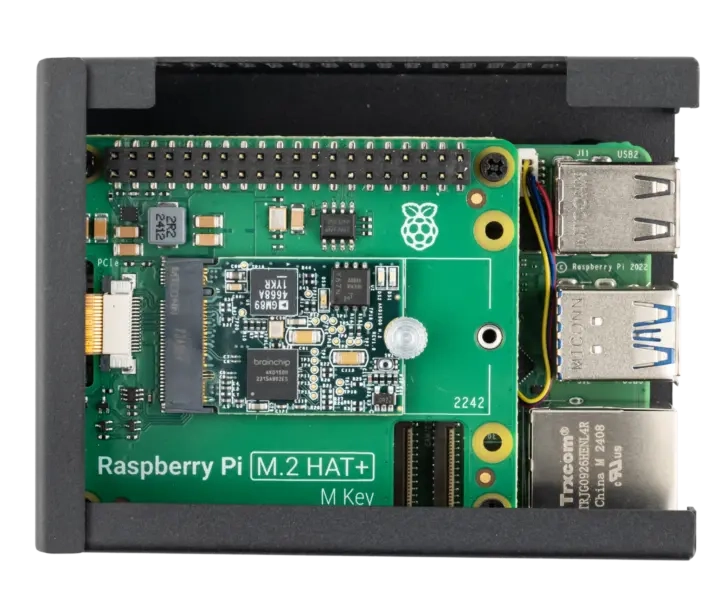
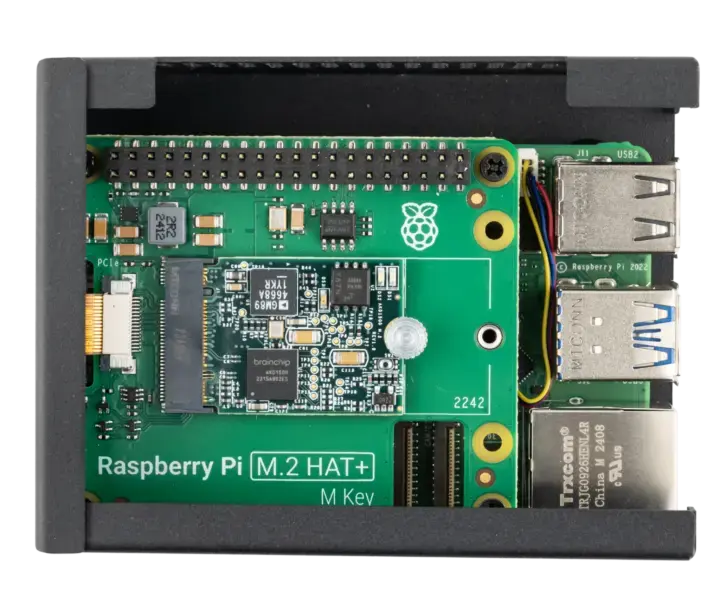
Hardware and connectivity: the kit combines a Raspberry Pi 5 8GB, the official M.2 HAT+ and an Akida AKD1500 M.2 B+M-Key card inside a metal case. Most of the Raspberry Pi 5’s ports stay accessible: Gigabit Ethernet, four USB ports, two HDMI outputs and the USB-C power port. Openings in the case also show the Raspberry Pi 5 power button and an LED on the M.2 HAT+. The kit needs a camera to work, but instead of a MIPI CSI Raspberry Pi Camera module, users have to connect a USB camera.
Software and demos: a 32GB SD card comes preinstalled with Ubuntu Server 20.04 LTS (to be confirmed), Python 3.7 and the MetaTF development environment. You connect a USB camera, put the Pi on your local network over Ethernet or WiFi, and type the kit’s IP address (for example 10.42.0.1 over WiFi) into a browser to open the Akida demo launcher. It offers a Visual Wake-Word (VWW) person-presence demo, YOLO object detection, an edge demo based on MobileNet and a MobileNet face demo, all running on the device.
Custom development: after the demos, you can build your own models with the MetaTF ML framework. Brainchip also lists Edge Impulse support, but only in the product brief, not in the user manual. Another feature is on-chip training, which lets models learn new classes on the device without retraining in the cloud.
Pricing: the kit sells for $1,295. The author accepts that a dev kit isn’t built to be cheap, but notes you could put together something similar from a Raspberry Pi 5 8GB ($175 MSRP), an M.2 HAT+ ($12), the Akida AKD1500 M.2 card ($129), a metal case such as the Geekworm P579 ($10.99) and a 32GB A1/A2 microSD card ($10-$20). That comes to about $350 plus taxes and shipping, plus around two hours of assembly and software installation. The author jokes that the kit only pays off if you earn more than about $400 an hour. More details are in Brainchip’s press release.
Critical Analysis
The article is short and useful. Its best part is the side-by-side cost breakdown, which is the deciding factor for most buyers. A markup of almost four times is hard to defend when the extra value is a case, a preconfigured software image and a few demos. That said, the math is a bit loose: about $945 saved over two hours works out to roughly $470 an hour, not $400. The comparison also leaves out things a company might pay for, like vendor support, warranty and a tested, known-good software stack. A bigger technical question deserved more attention. Ubuntu Server 20.04 and Python 3.7 are old: Python 3.7 reached end-of-life in 2023, standard support for Ubuntu 20.04 ended in 2025, and both came out before the Raspberry Pi 5. If confirmed, that would raise real doubts about how mature and maintained Brainchip’s software stack is. Requiring a USB webcam instead of the official MIPI CSI cameras is another limitation for anyone building prototypes close to a final product. Finally, the piece says little about what the neuromorphic approach actually delivers in power or latency compared with alternatives like Hailo-based AI HATs. That comparison would help readers decide whether the Akida ecosystem is worth paying more for.
Pros and Cons
| Pros | Cons |
|---|---|
| Ready to use, no assembly required | High price: $1,295 vs about $350 in parts |
| Metal case with most ports accessible | Outdated preinstalled software (Ubuntu 20.04, Python 3.7) |
| Browser-based vision demos (VWW, YOLO, MobileNet) | Requires a USB webcam; no documented MIPI CSI camera support |
| Fully local processing, no cloud | Edge Impulse support only mentioned in the product brief |
| On-chip training for learning new classes | A similar setup can be built in about two hours |
| MetaTF framework included for custom models | Aimed at companies, poor value for hobbyists |
Sources
Author: Jean-Luc Aufranc (CNXSoft)
URL: https://www.cnx-software.com/2026/11/02/brainchip-akd1500-raspberry-pi-5-dev-kit-enables-users-to-quickly-experiment-with-event-based-neuromorphic-ai/
Publication Date: 2026-11-02
Rights and Attribution
Images, logos, and photographs are the property of their respective owners. Used for commentary purposes.
← Back to blog