The Lagotto Romagnolo: history, art and scientific truth
The Lagotto Romagnolo is one of the most talked about breeds and, paradoxically, one of the most misunderstood. Over time, narratives have piled up around it that mix real history, local pride, and marketing. This article attempts to separate what we know for certain from what is legend.
The origins: ancient type, not ancient breed
A necessary and often overlooked distinction: there is a fundamental difference between an ancient type dog and an ancient breed.
The Lagotto Romagnolo is an ancient type dog — a rustic dog whose morphological characteristics have been documented iconographically for centuries, descending from the water dogs of the Romagna marshes. It is not, however, an ancient breed in the genetic sense of the term.
Genetic studies on dog breeds — including the work of Parker et al. (2004) — classify as “ancient” or basal those with documented direct genetic continuity for millennia: Akita, Basenji, Saluki, Chow Chow. Breeds that show early genetic divergence from the wolf and an unbroken linear continuity. The Lagotto does not fall into this cluster.
This does not make it any less interesting. It makes it more honest.
The Etruscan traces
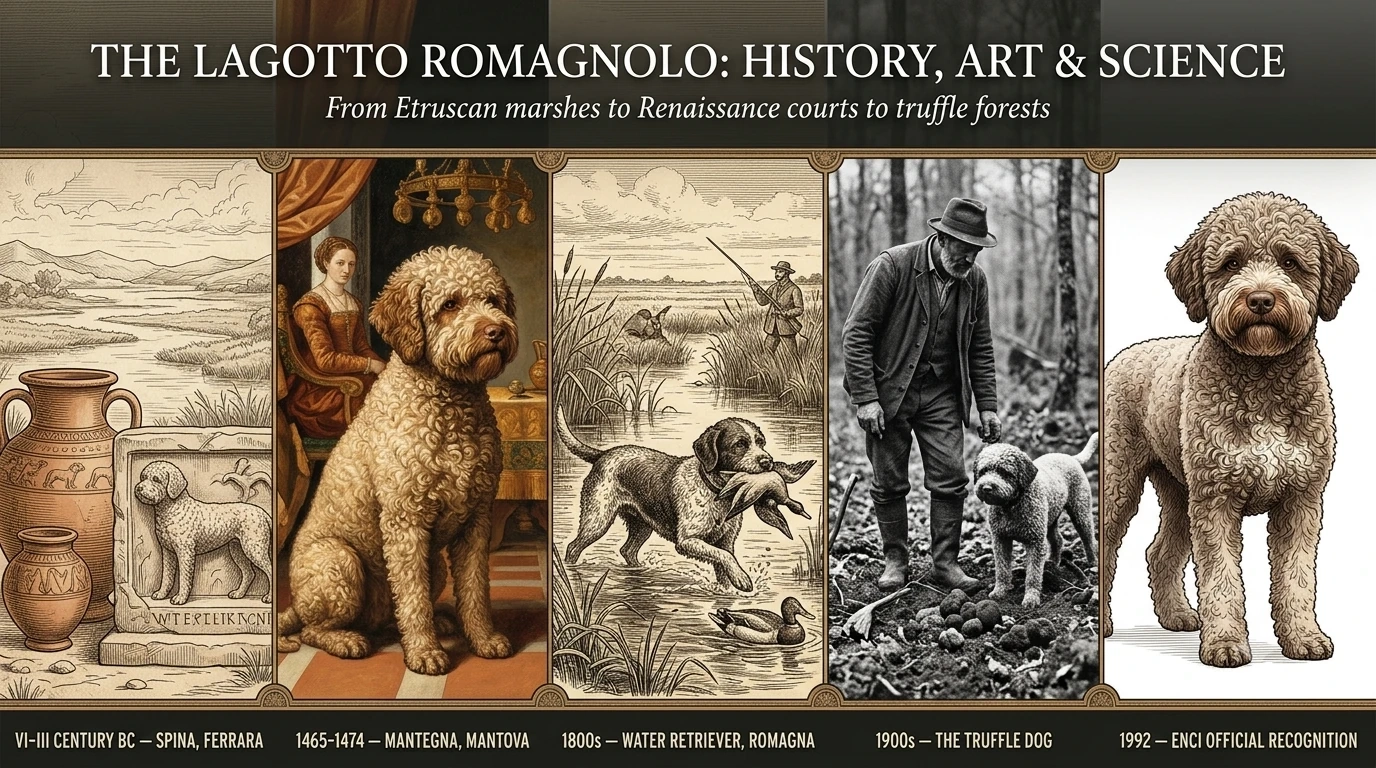
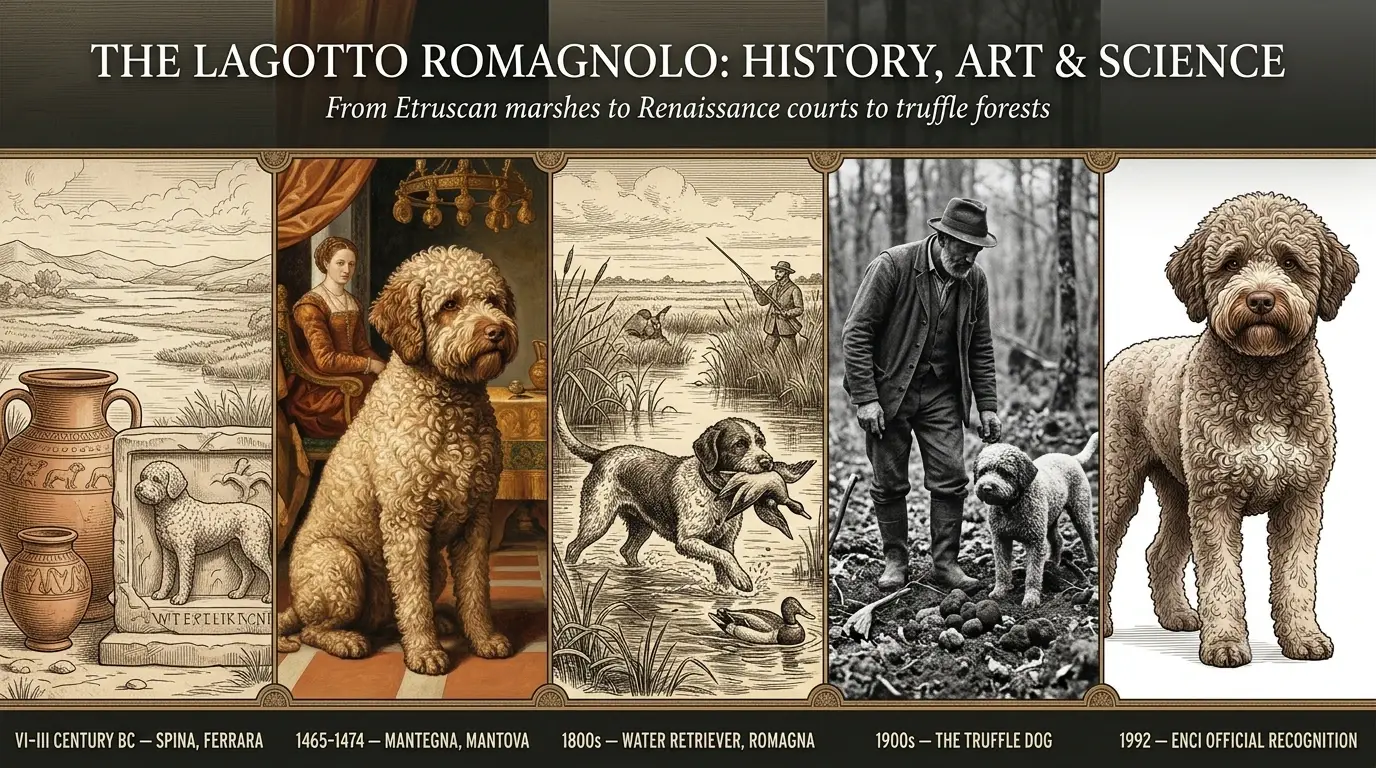
The earliest iconographic testimonies date back to the Etruscan civilization. In the necropolis of Spina — an Etruscan site from the 6th-3rd century BC located near Ferrara, at the mouth of the Po Delta — depictions have been found of an water dog morphologically similar to the Lagotto.
The Etruscan presence on the northern Adriatic since the 6th century BC places the first probable ancestors of these dogs exactly in the territory that will become their historical homeland: the valleys and marshes between Ravenna, Ferrara, and Comacchio.
This is not an absolute certainty — the iconographic identification of a specific breed in ancient representations is always subject to margins of interpretation. But the geographical and morphological context is consistent.
The Renaissance: painters and the Romagnolo dog
Between the 15th and 17th centuries, several Italian painters depicted dogs with characteristics compatible with the Lagotto type.
Andrea Mantegna — in the Camera degli Sposi in Mantova (1465-1474), fresco commissioned by the Gonzaga, features a dog with morphological characteristics consistent with the Lagotto type: curly fur, compact body, working dog posture.
Vittore Carpaccio — between 1490 and 1495, the Venetian painter documented in his works the presence of dogs of a similar type. Carpaccio worked mainly in Venice, in close contact with the culture of the Padano-Venetian hinterland.
Il Guercino and Lombard painters — between the 16th and 17th centuries, other representations attributable to the Lagotto type appear in works from the Lombard and Romagnolo regions.
It should be clearly stated: none of these painters were “portraying the Lagotto Romagnolo.” They were portraying the dogs of their own time and geographical context. The identification with the Lagotto type is a historical reconstruction, not a documented certainty. But it is a reconstruction consistent with the geographical distribution of the breed and the morphological characteristics represented.
The water work: the original function
The first written mention of the term “Lagotto” in a Romagnolo dialect dictionary dates back to 1876. The name presumably comes from the Romagnolo dialect “lago” — water mirror — indicating the original function of the dog: retrieving waterfowl in the valleys and marshes of Romagna.
For centuries the Lagotto has been a water dog: it retrieved game shot in the wetland areas of Ravenna, Ferrara, and the Po Delta. It was a rural working dog, not a show dog, not a status symbol. It was selected for its ability to work in difficult conditions — cold water, dense vegetation, marshy land — and for its cooperation with the handler.
The great reclamation and reconversion
Between the late 19th century and the first half of the 20th century, large hydraulic reclamation works radically transformed the Romagna territory. The valleys were drained. The marshes disappeared. Waterfowl drastically decreased.
The Lagotto was at risk of disappearing with them.
Its salvation was the reconversion to truffle searching — an activity for which its behavioral characteristics proved to be suitable: high olfactory drive, concentration ability in difficult environments, cooperation with the handler, fatigue resistance.
This reconversion was neither immediate nor planned. It occurred gradually, over decades, through the empirical work of Romagnolo truffle hunters who took the dogs they had into the woods. And the Lagotto — or Lagotto-type dogs — proved to be suitable.
The official recognition
The modern concept of “breed” implies a defined morphological standard and a closed pedigree book. For the Lagotto Romagnolo, this process is relatively recent.
Starting in the 1970s, Dr. Giovanni Morsiani initiated a systematic morphological study and selection work to fix and recover the typical characteristics of the breed, which throughout the twentieth century had interbred with other working dogs.
The official standard was approved by ENCI (Ente Nazionale della Cinofilia Italiana) in July 1992. International recognition by the FCI (Fédération Cynologique Internationale) followed in subsequent years.
The Lagotto is therefore a breed with ancient origins as a local canine type, but with a modern official standard — the result of a twentieth-century recovery and selection effort, not of an uninterrupted historical continuity.
The truffle: what science actually says
The debate on the superiority of the Lagotto in truffle hunting compared to other breeds or mixed-breed dogs deserves an honest answer, based on what scientific literature actually states.
First truth: there is no peer-reviewed scientific study that quantitatively compares the reactivity or accuracy in truffle hunting between a Lagotto Romagnolo and a mixed-breed dog.
Second truth: the sense of smell is a species capability, not a breed capability. Any dog possesses the necessary olfactory receptors and can be trained for truffle hunting. Ethological studies — including Čejka et al. (2022) and research on hunting dog behaviour — demonstrate that success in the search depends primarily on training, the dog’s motivation and the handler’s experience. Field research teams regularly use dogs of different breeds — Lagotto, Labrador, Springer Spaniel, mixed breeds — without reporting statistically significant differences in accuracy intrinsic to the breed.
Third truth: the real advantage of a certified working-line Lagotto is not a genetic “super-nose”. It is predictability. With a subject from a certified working line, the probability of obtaining a dog with high search drive, endurance, concentration in difficult environments and cooperation with the handler is statistically higher than choosing a mixed-breed dog of unknown origin. Not absolute superiority — risk reduction.
What holds, what doesn’t
Holds:
- Origins as a water dog in the Romagnol marshes, documented iconographically from the Etruscan period
- Renaissance pictorial representations of dogs compatible with the Lagotto type
- The transition to truffle hunting as a response to land reclamation
- The twentieth-century recovery and standardisation work
- Behavioural predictability as a real advantage of working-line selection
Does not hold:
- The idea that the Lagotto has a “truffle gene” making it superior to any other dog
- The definition of “ancient breed” in the genetic sense
- The claim that only the Lagotto can work as a truffle dog
- Any narrative that confuses the merit of selection (breeders) with a natural superpower (the breed)
A final note
The Lagotto Romagnolo is a breed with a genuinely interesting history — more interesting, probably, than the simplified version circulating online. It survived the disappearance of its original habitat, adapted to a different function, risked extinction and was recovered through the work of a few dedicated enthusiasts.
It does not need legends.
The real story is already enough.
Sources and references
Cynophilia and official standards:
- ENCI — Official Lagotto Romagnolo Standard
- FCI — Standard N° 298 Lagotto Romagnolo
- Italian Lagotto Romagnolo Association
Canine breed genetics:
- Parker HG et al. (2004) — Genetic Structure of the Purebred Domestic Dog — Science 304(5674):1160-4 https://www.science.org/doi/10.1126/science.1097406
Behaviour and truffle hunting:
- Čejka et al. (2022) — research on search dog behaviour in natural environments https://pmc.ncbi.nlm.nih.gov
- ScienceDirect — ethological studies on working dogs
Breed history:
- Northwest Lagotto — historical documentation
- History of veterinary medicine — pictorial representations
- AKC — Lagotto Romagnolo breed history
- Lagotto Romagnolo Club of America
Renaissance art:
- Camera degli Sposi, Andrea Mantegna (1465-1474) — Palazzo Ducale, Mantova
- Vittore Carpaccio, works 1490-1495 — Gallerie dell’Accademia, Venezia
Author: Giantommaso Fogli
Publication Date: 2026-07-13
Rights and Attribution
Images, logos, and photographs are the property of their respective owners. Used for commentary purposes.
← Back to Lagotto